
The Ride, The Room, & Real-Time Feedback
The patient experience is made of many layers. It isn’t just about cleanliness. It isn’t just about communication. It isn’t just about care transitions.
It’s about all those things—plus plenty more.
That’s why making significant improvements to the overall patient experience demands a broader perspective. That’s why thinking about the big picture is the only way to increase your scores from the Hospital Consumer Assessment of Healthcare Providers and Systems (HCAHPS)—scores tied directly to your hospital’s funding and referral traffic.
You simply can’t do it all. Addressing every in-the-moment issue is the right goal for each shift, but moving the needle on patient satisfaction means deciding on which moments most affect the patient experience. Then, bringing those experiences in line with your (sometimes aspirational) standards. In practice, patients remember a handful of moments that shape their whole story, whether someone showed up when they said they would, whether the room felt calm enough to rest, and whether concerns were acknowledged and addressed in the moment. That’s the difference between care delivered and care felt.
Yes, everything needs to be clean. Yes, the discharge experience needs to be thorough. Yes, your communication needs to be clear. And yes, your facilities need to be conducive to healing.
Sounds like a lot. But, you don’t solve all those problems by running in a dozen different directions. You solve them by focusing on what matters most—on what is guaranteed to bring about the most change. For the patient experience (and for HCAHPS scoring!) that means three distinct things: (1) the transport, (2) the environment, and (3) the services themselves. Or, the ride, the room, and real-time feedback.
Because these three services are so interconnected, they’re some of the fastest ways to elevate the patient experience of any hospital. Their influence sends a ripple effect across every section of your HCAHPS scorecard.
1. Accessible & on-time transitions.
Patient transportation is an essential part of healthcare. For some patients, it’s one of their first interactions with the system as the beginning of a longer healing process. For others, it’s a critical transition between facilities or departments to get the care and resources they need. For every patient, it’s a piece of their journey that blurs the line between patient comfort and patient experience. For patients, a delayed transport rarely feels like a scheduling issue; it feels personal. “When transport is late, I don’t just feel delayed, I feel forgotten.”
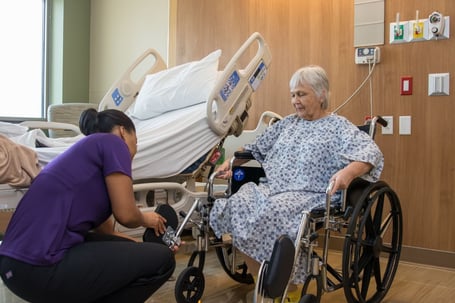
Patient transportation creates big first impressions, and it can alter a patient’s perception of the hospital services they receive, especially if those patients are already in painful or stressful situations. This makes care transitions not only a serious consideration for the patient experience overall, but also one of the most influential components of HCAHPS scoring. Patient transport might not have its own box on the HCAHPS scorecard, but it is one moment of execution capable of coloring the entire story one way or the other.
In fact, an analysis of the HCAHPS Three-State Pilot Program suggests some of the biggest influences on the patient experience actually come from outside the hospital. This could include overall mood or inclement weather, but patient transportation is still a big slice of this increasingly large pie.
So, what types of care transitions create a better patient experience? What types of patient transportation, whether house-to-hospital or room-to-room, give a measurable boost to your HCAHPS rating from the very beginning? It boils down to three words.
- ACCESSIBLE. Millions of patients delay non-emergency medical treatment every year due to a lack of transportation, and those numbers are only going up.
- PUNCTUAL. Late or delayed transportation can create serious stress for a patient, most especially when dealing with pain management or emergency care.
- PEACEFUL. Patient transportation that creates additional physical or emotional stressors is counterproductive. For transitions between facilities, high-stress transportation can exacerbate the patient’s condition.
If your transportation resources satisfy these three standards, then they’re likely a net positive for your patient experience. If they don’t, then they’re one of the very first things standing in the way of you improving your standard of care and improving your HCAHPS ratings across the board.
2. Calm & quiet environments for healing.
Silence and serenity are fundamental to an effective healing process. Not only does silence give the body more time and space for healing, but it also makes everything else about the patient experience more effective and more satisfying.

Noise pollution also negatively impacts the medical services being rendered. Excessive noise can interfere with clinical procedures and increase patient anxiety. Beyond that, one study shows that disruptive environments can be especially damaging for those in intensive care, causing an increase in both physical and physiological symptoms. Patients don’t experience noise as an inconvenience; they experience it as a barrier to healing. “Noise at night makes me feel unsafe and unable to rest.” Quiet is clinical, but it’s also emotional. It signals protection, respect, and dignity.
Why?
Consistent communication. Precise pain management. An informative discharge. All of these “must-haves” for successful healthcare can get completely derailed by too much noise. That’s why these outcomes can do real damage—or real repair—to both a hospital’s reputation and its ultimate HCAHPS ratings.
So, how do successful hospitals do it? How do they consistently create calming environments for their patients? It’s all about making the right choices at the right times.
- THE RIGHT PROCEDURES. Maintaining a calm environment isn’t possible without proactive processes and procedures in place. How clear and confident are yours?
- THE RIGHT MONITORING TECHNOLOGY. This can make all the difference in both execution and remediation. Do your noise monitoring systems give you the real-time feedback and decision-making data you need? Most forward-thinking hospitals are partnering with highly advanced third-party companies to keep their healing environments quiet.
- THE RIGHT WAY TO RESPOND. How do you respond when noise pollution gets out of control? Is that response immediate and impactful? If not, what steps do you need to take to reach that level of preparedness?
Most hospitals do some of this right—perhaps a little, perhaps a lot. The rare few hospitals that meet and exceed these standards are invariably the hospitals with the most referrals and the highest HCAHPS ratings.
Why? Because they’ve prioritized silence and serenity when drafting plans and making institutional purchases—plans and purchases with the patient experience at the center.
3. An active ambassador program.
Ambassador programs are tied to every part of the patient experience—the ride, the room, and the real-time feedback; or, the transport, the environment, and the services themselves. What’s more, patient ambassadors are your only reliable peek into the day-to-day satisfaction scores at your hospital.
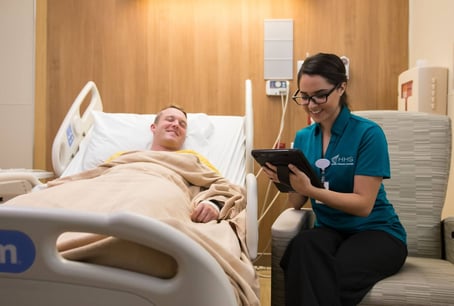
These programs can succeed in big ways, such as the Texas hospital that used its ambassador program to go from a 55% to a 96% patient satisfaction score in just one year. Plus, these ambassadors leave patients feeling more welcome and relaxed by translating complex medical information and offering emotional support.
When it comes to HCAHPS, patient ambassadors are indispensable. If something slips through the cracks—if the hospital’s performance in some section of the HCAHPS scorecard is on the decline—patient ambassadors will be the first ones to take notice.
That said, what are the most critical characteristics of successful ambassador programs?
- A CLEAR MISSION & GOALS. The best patient ambassador programs have a well-defined purpose. If they’re simply collecting information, they do so in a targeted way. If they are looking for feedback, they ensure that feedback is meaningful and robust.
- TRAINED & SUPPORTED AMBASSADORS. Collecting and sharing information to improve a lived experience isn’t something that comes naturally. You need to know what information is important and how to distill that information into something useful.
- MULTIPLE ENGAGEMENT OPPORTUNITIES. Face-to-face conversations. Telemeetings. Video testimonials. Public speaking. Ambassador feedback gets better and more frequent with each additional engagement opportunity.
If you want your patient satisfaction score to stay healthy, an active patient ambassador program is the only way to keep your finger on the pulse. It’s the only way to get a sense of your hospital’s patient experience from moment to moment.
A Necessary Shift in Focus
Caring for patients is a mad dash of meeting needs and communicating medical information. You can’t prevent every problem, and you can’t guarantee perfection.
However, you can prioritize three factors with an undeniable effect on the patient experience: the transport, the environment, and the services themselves. Or, the ride, the room, and the real-time feedback.
—
Want to see what’s possible?
You could be discussing your HCAHPS scorecard with an HHS expert as soon as tomorrow!
